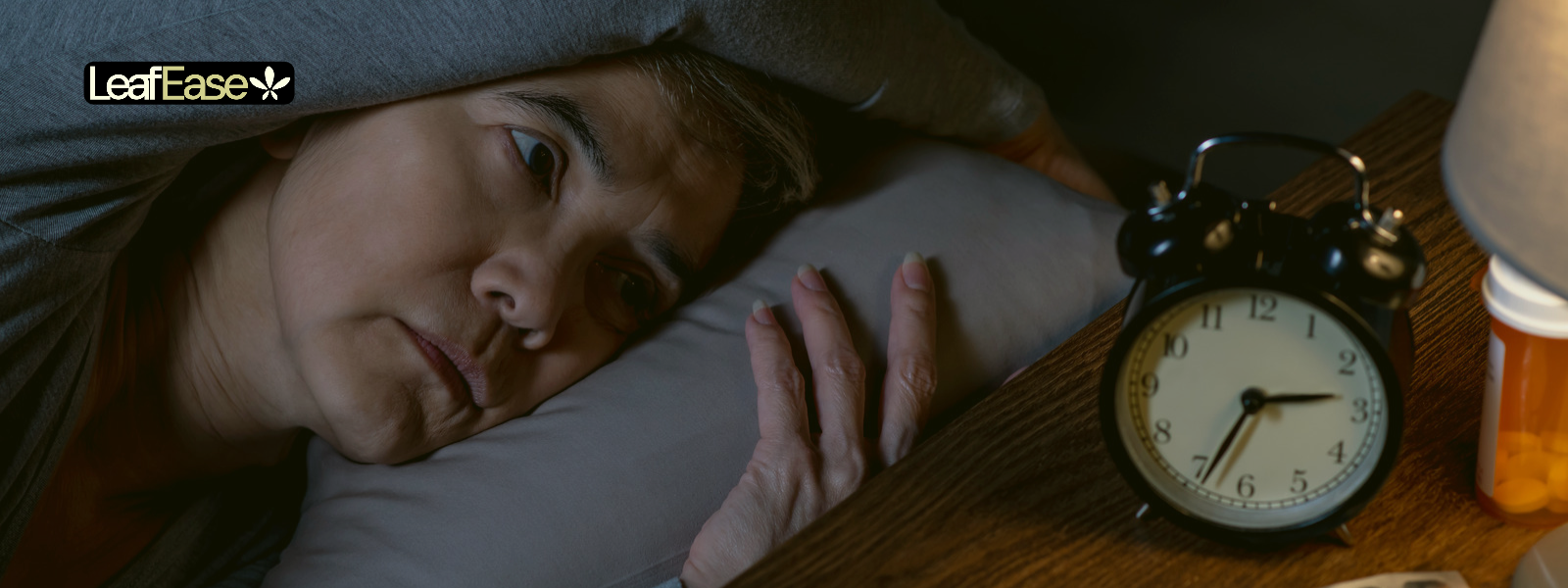



You’re exhausted, but you can’t sleep. Your body knows how tired it is, but it just won’t switch off. Maybe you’ve tried it all: the tablets your GP prescribed, the sleep hygiene routines, the lavender pillow spray, but nothing seems to help .
Medical cannabis isn’t the first thing most people reach for when struggling with a healthy sleeping routine, but for many, it’s what eventually works when nothing else does. In the UK, insomnia is a recognised qualifying condition for a legal private prescription, and the evidence behind it is growing. Here’s what you need to know.
Key Takeaways:
- Insomnia is a recognised qualifying condition for a legal medical cannabis prescription in the UK.
- Medical cannabis for insomnia is only prescribed after at least two conventional treatments have failed to provide sufficient relief.
- Research from the UK Medical Cannabis Registry shows improvements in sleep quality, anxiety, and quality of life in insomnia patients over 18 months.
- NHS access is extremely limited; most patients access treatment through a private specialist clinic.
- You do not need a GP referral to begin the process.
Does Medical Cannabis Actually Help With Poor Sleep
If you’ve spent months or years trying treatments that don’t deliver enough relief, the question isn’t just whether medical cannabis works. It’s whether it might work for you specifically. For cases where conventional treatments haven’t been sufficient, there’s encouraging evidence, though it’s still developing. It could be the right treatment for you only if you’ve tried at least two conventional treatments first. This is where “poor sleep” becomes chronic insomnia, which can affect your life and health.
For such cases, there’s encouraging evidence proven by research, though it’s still developing. A landmark 2024 study published in Brain and Behaviour by researchers from Imperial College London analysed outcomes from patients enrolled in the UK Medical Cannabis Registry (UKMCR) who had been prescribed cannabis-based medicinal products (CBMPs) for insomnia. Participants reported meaningful improvements in sleep quality at one, three, and six months, and the researchers also observed improvements in anxiety and general quality of life alongside better sleep. [1]
Building on this, a larger follow-up study published in PLOS Mental Health in August 2025, analysing 124 patients over 18 months, found that improvements in sleep quality, anxiety, and health-related quality of life were observed across the full follow-up period, with side effects that were generally mild or moderate. [2] No disabling or life-threatening reactions were reported. This is a big step towards a medical breakthrough for insomnia patients, showing that medical cannabis can indeed help with insomnia.
What is the Science Behind Medical Cannabis as Treatment for Insomnia
Most sleeping pills work by sedating the brain. Medical cannabis takes a different approach, working with a system the body already has for regulating sleep rather than overriding it. The endocannabinoid system (ECS) is a network of receptors throughout the body that plays a role in regulating the sleep-wake cycle. Preclinical research suggests that both CBD (cannabidiol) and THC (tetrahydrocannabinol), the two primary active components in medical cannabis, may have sleep-promoting properties by interacting with this system. [3]
This means the science behind medical cannabis as a treatment for insomnia is real but still maturing. It also means medical cannabis for insomnia is prescribed with care and clinical oversight, not handed out freely.
Poor Sleep and Medical Cannabis: Who Can Qualify for a Prescription
There are specific eligibility criteria for getting medical cannabis for insomnia in the UK, and it’s important to understand them clearly. Insomnia is a recognised qualifying condition for a private medical cannabis prescription in the UK. However, you’ll need to meet the following criteria to be able to access it as a treatment:
You must have a confirmed diagnosis
A clinician needs to see that you’ve been formally assessed for insomnia. Not being able to get proper sleep for a few days due to conditional reasons is usually not a qualifying factor. It has to be assessed as a recognised condition impacting your daily functioning by a certified clinician.
You have tried at least two conventional treatments without sufficient benefit
This is the central gatekeeping requirement. In line with UK prescribing regulations, cannabis-based products for insomnia are reserved for individuals who have not gained enough relief from two or more licensed therapies. [1] This might include CBT-I (cognitive behavioural therapy for insomnia), sleep medications such as Z-drugs or certain antihistamines, or similar prescribed pharmacological interventions in this category.
Consider someone who has been dealing with chronic insomnia for two years. They completed a full course of CBT-I and were prescribed zopiclone, which helped initially but stopped working after a few weeks. Sleep is still broken, concentration at work has suffered, and anxiety has worsened because of it. This is exactly the kind of history a specialist looks at when assessing eligibility. It isn’t about how severe the insomnia sounds on paper. It’s about whether the treatments tried so far have genuinely been enough.
You are 18 or over
Patients who might be suffering from sleeping disruptions at a younger age require a specialist paediatric referral. Private medical cannabis clinics in the UK assess adults.
There are no clear contraindications
A history of psychosis, for example, would typically disqualify your eligibility, as THC can exacerbate certain mental health conditions. Your full medical history will be reviewed.It’s also worth understanding that NHS access to medical cannabis is extremely limited. NICE guidelines currently restrict NHS prescriptions to a small number of conditions, such as severe childhood epilepsy, MS-related spasticity, and chemotherapy-induced nausea. For insomnia, the practical route is through a private specialist clinic that can help check your eligibility.
What about feeling groggy the next morning?
This is one of the most common concerns among people who already wake up exhausted. The answer depends on the formulation. CBD-dominant and lower-THC options are generally associated with less next-day sedation than higher-THC products. Timing also matters. Your prescribing clinician will ask about your morning routine, whether you drive, and how your body typically responds to medication before recommending a starting point. If the first approach causes morning grogginess, the formulation or timing is reviewed and adjusted. The aim is better sleep and a clearer morning, not a trade-off between the two.
What Happens If You Don’t Qualify? Understanding the “Two Treatment” Rule
The requirement to have tried at least two treatments isn’t designed to be a wall but a clinical safeguard. It ensures that medical cannabis is used where there’s a genuine unmet need, rather than replacing treatments that might still work effectively. If you’ve only recently started experiencing sleep difficulties or haven’t yet tried CBT-I or any prescribed medication, a specialist may advise exploring those routes first. This shouldn’t feel like a rejection for the treatment. It’s a system designed to put patients’ wellbeing first rather than advocating for any one line of treatment without understanding the root cause.
But if you’ve already been through the conventional options and are still struggling, you might be the kind of patient this treatment pathway was designed for. Maybe it’s time for you to explore medical cannabis as an alternate treatment option for insomnia.
Could Medical Cannabis Be an Option for You?
Many people spend sleepless nights wondering why nothing works. Getting clarity on whether there is a clinical route forward is worth a few minutes of your time.
At LeafEase, ongoing care is built into the model. The subscription plan covers follow-up consultations with your clinician, continuity of care with the same specialist who knows your history, and free home delivery. Your clinician monitors how treatment is working and adjusts the formulation or dose around your daily routine where needed. If prescribed, medication is dispensed by a licensed pharmacy partner and delivered to your door in plain, discreet packaging with no indication of the contents on the outside.
A free eligibility check takes a few minutes and gives you an honest answer before you take another step.
You can check your eligibility in a few minutes to find out whether a consultation is the right next step for you.
Frequently Asked Questions
Can you get medical cannabis for insomnia in the UK?
Yes. Insomnia is a recognised qualifying condition for a private medical cannabis prescription in the UK. You must have a confirmed diagnosis and have tried at least two conventional treatments without sufficient relief before a specialist will consider prescribing.
Does medical cannabis help with insomnia?
Research from the UK Medical Cannabis Registry shows that patients prescribed cannabis-based medicinal products for insomnia reported improvements in sleep quality, anxiety, and overall quality of life at one, three, six, twelve, and eighteen months. It is not a cure, but for patients who have exhausted other options, the evidence is encouraging.
Do I need my GP to refer me?
No. You can book a consultation with a private specialist prescriber like LeafEase directly. It helps to have your medical records and a rough idea of what treatments you’ve already tried, but you don’t need a referral letter to get started.
What treatments do I need to have tried before I qualify?
You need to have tried at least two licenced treatments, this might include CBT-I (cognitive behavioural therapy for insomnia), Z-drugs, certain antihistamines, or other prescribed sleep medications. A specialist will review your treatment history during your consultation.
Is it safe?
Medical cannabis is generally well tolerated when it’s prescribed and monitored by a specialist. Like anything, it can have side effects: fatigue, dizziness, or changes in mood. Your prescriber will go through your full health history before recommending anything, so you’re not going in blind.
What type of medical cannabis is prescribed for insomnia?
Depending on your needs and medical history, a specialist may prescribe cannabis oils, capsules, or dried flowers for vaporisation. The ratio of CBD to THC will be adjusted based on your symptoms, with the aim of improving sleep while keeping psychoactive effects clinically appropriate and minimal.
Is medical cannabis for insomnia available on the NHS?
No. NHS access to medical cannabis is limited to a very small number of conditions, like severe epilepsy, MS-related spasticity, and chemotherapy-induced nausea. For insomnia, a private specialist clinic is the only practical route in the UK.
References
[1] Vivek, K. et al. (2024). UK Medical Cannabis Registry: Assessment of clinical outcomes in patients with insomnia. Brain and Behaviour, 14(2), e3410. Available at: https://doi.org/10.1002/brb3.3410 [Accessed: 8 May 2026].
[2] Aggarwal, A. et al. (2025). UK Medical Cannabis Registry: A clinical outcomes analysis for insomnia. PLOS Mental Health, 2(8), e0000390. Available at: https://doi.org/10.1371/journal.pmen.0000390 [Accessed: 8 May 2026].
[3] Vivek, K. et al. (2025). Medical cannabis and insomnia: a review. British Journal of Neuroscience Nursing. Available at: https://doi.org/10.12968/bjnn.2024.0011 [Accessed: 8 May 2026].